The Evolution of iPhone Scams: From Phone Theft to Digital Extortion
How iPhone scams have transformed over the last 15 years — from street theft and counterfeit devices to sophisticated digital extortion, remote locking, and ransomware. A global trend you need to understand.
The iPhone Revolution – And the Scams That Followed
When Steve Jobs unveiled the first iPhone in 2007, it changed the world. But where there is valuable technology, there are criminals. Over the past 18 years, iPhone scams have evolved dramatically — from simple street theft and counterfeit devices to sophisticated digital extortion, remote locking, and global ransomware operations.
This evolution mirrors the technology itself. As Apple introduced new security features (Find My iPhone, Activation Lock, Two-Factor Authentication), scammers adapted, finding creative ways to exploit the very systems designed to protect users. Today, the most dangerous iPhone scams don't involve physical theft at all — they involve psychological manipulation and remote control.
Understanding this evolution is key to protecting yourself. The scammers of today are not your average thieves — they are organized, tech-savvy, and psychologically sophisticated. Here is how we got here.
Era 1: The Physical Age (2007–2012) – Stealing the Device
Overview: In the early years, iPhone scams were simple and physical. The goal was to obtain the device itself, not the data or the account.
Common Scams:
- Street theft: Snatching iPhones from hands, bags, and pockets. This was a crime of opportunity.
- Pickpocketing: Stealing from crowded places — concerts, public transport, tourist attractions.
- Counterfeit iPhones: Selling fake devices that looked like iPhones but ran Android or had no functionality. These were often sold in tourist areas or via early online marketplaces.
- Stolen device resale: Thieves would wipe stolen iPhones (iOS was relatively easy to bypass back then) and resell them as used devices.
Why these worked: Early iPhones had limited security features. There was no Activation Lock, Find My iPhone was basic, and wiping a device was straightforward. The value was in the hardware.
The turning point: In 2013, Apple introduced Activation Lock with iOS 7. This was a game-changer. Suddenly, stolen iPhones became much harder to resell — they were effectively bricked without the original Apple ID password. Physical theft lost its profitability.
Era 2: The Security Arms Race (2013–2017) – From Device to Account
Overview: Apple's new security features forced scammers to shift their focus. Instead of stealing the device, they started targeting the Apple ID account itself.
Key Developments:
- Activation Lock introduced (2013): Made stolen iPhones nearly worthless for resale. Scammers needed the Apple ID credentials to unlock devices.
- Find My iPhone became standard: Users could now track, lock, and erase their devices remotely. This was a powerful anti-theft tool.
- Rise of phishing: Scammers began sending fake Apple emails to steal Apple ID passwords. The goal was to unlock stolen devices or to access iCloud data.
- First iCloud hacks: In 2014, the 'Celebgate' scandal exposed how scammers were using phishing and brute-force attacks to breach Apple IDs and steal private photos.
- Stolen device resale shifts: Instead of selling the device itself, thieves would harvest the Apple ID credentials and sell them on the dark web.
Why these worked: The weakest link was no longer the hardware — it was the user. Scammers realized that tricking users into giving up their passwords was easier than picking pockets. Social engineering began to replace physical theft.
The turning point: In 2015, Apple introduced Two-Factor Authentication (2FA). This made password theft alone insufficient — scammers now needed access to a trusted device or phone number. The cat-and-mouse game escalated.
Era 3: The Social Engineering Age (2018–2022) – Trust Exploitation
Overview: With physical theft becoming less profitable and 2FA making account theft harder, scammers turned to the most effective weapon: human psychology. This era saw the rise of scams that exploited trust, urgency, and relationships.
Common Scams:
- Fake Apple Support calls: Scammers impersonated Apple Support, claiming security issues and asking for passwords or 2FA codes. This is the Authority Bias we covered in our psychology guide.
- Account takeover via messaging apps (WhatsApp, Telegram): Scammers hijacked messaging accounts and used them to message contacts, asking them to sign into a 'test' Apple ID. This exploited personal trust.
- Marketplace scams (OLX, Avito, Facebook Marketplace): Fake buyers would meet sellers in person and trick them into signing into a scammer's Apple ID, then remotely lock the device. This targeted sellers specifically.
- Social media romance scams: Scammers built relationships over months on dating apps, then asked victims to sign into 'their' Apple ID for a seemingly innocent reason, only to lock the device.
Why these worked: Apple's security was now robust. The only way in was through the user. Scammers became skilled manipulators, using emotional triggers (fear, love, greed, urgency) to bypass logical thinking. The device itself became the hostage.
The turning point: In 2022, Apple introduced Stolen Device Protection (iOS 17.3), requiring a 1-hour delay for critical security changes when away from trusted locations. This made it harder for scammers to lock devices remotely. But scammers adapted again.
Era 4: The Ransomware Age (2022–Present) – Digital Extortion
Overview: Today's most dangerous scams are digital extortion. Scammers no longer need to steal your device or even your password — they need you to voluntarily give them control by signing into their Apple ID. Once done, they hold your device for ransom.
Key Characteristics of the Current Era:
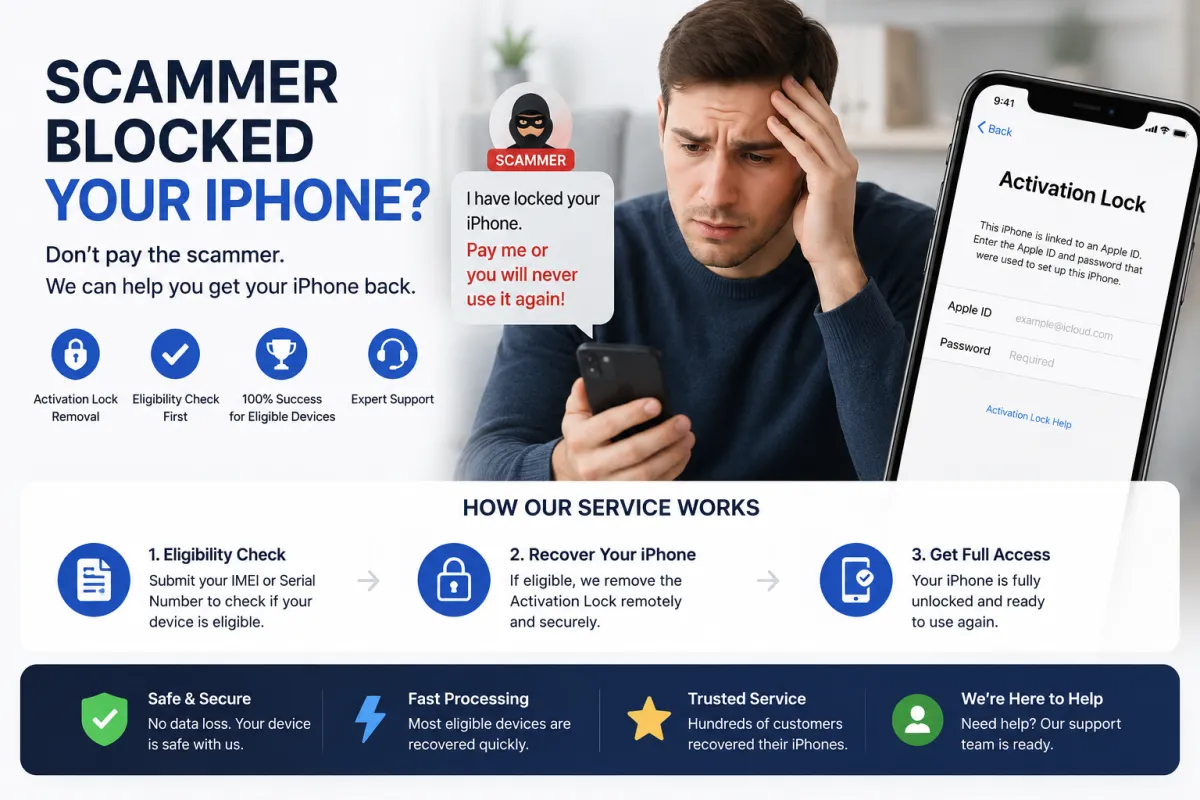
- Activation Lock ransom: Scammers lock your device through Lost Mode or Activation Lock and demand payment (typically $100–$500 USD in cryptocurrency or gift cards) to unlock it.
- Sophisticated social engineering: Scammers use elaborate stories and multiple messages to build trust before springing the trap. They may pose as buyers, sellers, friends, or support staff.
- Global organized crime: These scams are run by organized groups operating across borders. They use scripted conversations, multiple accounts, and automated tools.
- Psychological warfare: Scammers threaten to erase data, expose private information, or sell your data on the dark web. The emotional toll is as damaging as the financial loss.
- Multiple victimization: A single scam can affect both the direct victim and all their contacts, who receive scam messages from the hijacked account.
Why this works: Scammers have become masters of manipulation. They understand that people are more likely to comply with a request that seems to come from a trusted source (friend, family, tech support) than from a stranger. They also know that fear of losing data is a powerful motivator.
Why it is a global problem: This is not limited to one country or platform. We have seen these scams in the US, Europe, Russia, the CIS, and beyond. The scale is enormous. In 2023 alone, millions of dollars were paid in ransomware to iPhone scammers.
The Shift from Crime of Opportunity to Organized Crime
One of the most significant changes is the professionalization of iPhone scams. In the physical age, thieves were often opportunistic individuals. Today, these scams are run by organized groups.
- Scripted operations: Scammers have detailed scripts for every scenario — whether they are posing as Apple Support, a buyer on OLX, or a friend on WhatsApp.
- Multiple accounts: They operate dozens of accounts simultaneously, making it hard for platforms to detect and ban them.
- Dark web infrastructure: Scammers buy and sell Apple ID credentials, IMEI lists, and phishing tools on the dark web.
- Global reach: A scammer in Russia can target victims in the US, Europe, or Australia. Language barriers are overcome with translation tools.
- Ransomware-as-a-Service: Some groups sell 'locking kits' to less sophisticated criminals, enabling anyone to run these scams.
This professionalization means that the average user is facing a sophisticated adversary. You are not just fighting a single scammer — you are fighting a well-funded, well-organized criminal ecosystem.
How Scammers Monetize Your Locked Device
Once your device is locked, scammers have several ways to profit:
- Direct ransom: The most common method. They demand $100–$500 to unlock the device. Payment is usually in cryptocurrency (Bitcoin, USDT) or gift cards (Apple, Google, Amazon). These are irreversible, anonymous, and hard to trace.
- Selling your Apple ID: If they gained access to your Apple ID, they may sell it on the dark web. A verified Apple ID with payment methods and iCloud data can sell for $100–$300.
- Selling your data: Photos, contacts, messages, and documents can be sold or used for further identity theft and blackmail.
- Using your saved cards: If they accessed your Apple Pay or iTunes account, they may make fraudulent purchases.
- Selling the device: Even a locked iPhone has value for parts. Some scammers sell locked devices to parts dealers or refurbishers.
- Extortion campaigns: Some scammers threaten to expose private photos or messages unless you pay.
Geography of iPhone Scams – A Global Problem
iPhone scams are not limited to one region. Here is a snapshot of the global landscape:
- Eastern Europe & CIS (Russia, Ukraine, Belarus): OLX and Avito scams are particularly prevalent. Fake buyer and fake seller scams are common. Telegram is also widely used.
- United States & Europe: Facebook Marketplace scams, fake Apple Support calls, and phishing attacks are widespread. WhatsApp account takeovers are common.
- Southeast Asia: SIM-swapping and phishing are major threats. Scammers often operate from call centers in the region.
- Latin America: Street theft and robbery remain common, but digital scams are increasing as iCloud adoption grows.
- India & Middle East: OLX (in India) is a hotspot for the seller scam we described. WhatsApp scams are also pervasive.
The common thread is that scammers adapt to local platforms and payment methods. The core tactics (social engineering, urgency, Authority Bias) are universal.
What This Means for You – Why Prevention Is Critical
The evolution of iPhone scams shows a clear trend: scammers are becoming more sophisticated, and the cost of a mistake is higher. A stolen physical device could be replaced. A digitally extorted device holds your data, memories, and sometimes your entire digital life hostage.
This is why prevention is so critical. It is much easier to avoid being scammed than to recover from one. Here is your action plan:
- Never sign into someone else's Apple ID — this is the #1 rule. No legitimate transaction requires this.
- Enable Two-Factor Authentication (2FA) on your Apple ID to prevent unauthorized access.
- Be skeptical of any unsolicited contact — whether it's a call, email, or text. Verify independently.
- Educate your contacts — warn them about the WhatsApp/Telegram scam so they don't fall for it.
- Keep your software updated — always install the latest iOS updates for security patches.
- Use strong, unique passwords — never reuse passwords across services.
- Check the IMEI before buying a used iPhone — ensure it is not blacklisted or Activation Locked.
If you are already a victim: Do not pay the ransom. Contact Apple Support with proof of ownership, or use our free eligibility checker to see if your device can be unlocked through our service. We are here to help you regain access without rewarding criminals.
Frequently Asked Questions
Q1: Why have iPhone scams moved online?
A: Apple's security features (Activation Lock, Find My iPhone, 2FA) made physical theft less profitable. Scammers shifted to targeting accounts and users directly because it's easier and more lucrative.
Q2: Are iPhone scams organized?
A: Yes. Many are run by organized crime groups with global reach. They use scripted conversations, multiple accounts, and dark web infrastructure.
Q3: Are people in all countries affected?
A: Yes. While platforms vary (OLX in Russia/CIS, Facebook Marketplace in the US, OLX in India), the tactics are universal.
Q4: Why do scammers use cryptocurrency and gift cards for ransom?
A: These payment methods are irreversible and anonymous. Once sent, the money is gone and cannot be traced easily.
Q5: Has Apple stopped evolving its security?
A> No. Apple continues to improve security with features like Stolen Device Protection, Account Recovery Contacts, and hardware-based security keys. However, scammers adapt quickly.
Q6: Will these scams ever stop?
A: Unfortunately, no. As long as iPhones are valuable, there will be scammers. The best defense is education and vigilance.
Q7: What is the most dangerous type of iPhone scam today?
A: Ransomware-style digital extortion via Activation Lock is currently the most devastating because it holds your data and device hostage.
Q8: How can S7OFF help victims of modern iPhone scams?
A> If your device is locked by a scammer via Activation Lock, S7OFF provides a legitimate unlock service. Use our free eligibility checker to see if your device can be unlocked. We offer a 100% success guarantee for eligible devices — no ransom payment required.
Q9: Is paying the ransom ever a good idea?
A: No. Paying the ransom encourages scammers and does not guarantee unlock. Scammers often demand more money or disappear after payment.
Q10: How can I stay informed about new scams?
A: Follow trusted cybersecurity blogs, Apple's official security updates, and our blog. We regularly update our guides with new scam patterns.